
Website accessibility audit: cost, quotes and how to choose an auditor


You need an accessibility audit of your website, to publish a statement, answer a buyer or show that you comply, and you can't tell what a fair price looks like. Official European benchmarks run from €2,000 to £30,000, and your price depends on the pages tested. We show how to estimate it, then compare quotes up to signing: fixes have a budget of their own.
From the page sample to the signed quote
#What is a website accessibility audit?
An accessibility audit checks whether the pages of a site meet a list of requirements, called success criteria, and every criterion a page fails counts as an issue. It covers a selection of the site's pages, called the sample. The reference list is WCAG, the international standard for web accessibility, usually at its middle level, AA. An accessibility audit of a building under the ADA is a different job, with different rules.
Some issues stay invisible when you browse with a mouse and good eyesight. Take a menu that won't open from the keyboard, or a button that the screen reader, the software that reads the screen aloud, announces with no name. The product list of Simmer & Co., an online cookware store, has both. We follow its audit order here, from the sample to the quote.
 Marker 1. The Filters menu, above the products. Marker 2. The four add-to-cart buttons, icons with no text.
#How an auditor tests each page?
To find them, the auditor goes through every success criterion of the target level on each page of the sample, and part of the testing happens in the page's code. For a few criteria, especially those about scripts, the code that makes the page react, the auditor also listens to what a screen reader says. You agree on the pairs of screen reader and browser before testing, NVDA with Firefox for example. The official evaluation method calls that list the accessibility support baseline.
The audit then states, page by page, which criteria pass and which fail. The standard itself gives no score, and its evaluation method leaves any overall score optional, provided the auditor documents how it is calculated. France's RGAA, the national method built on WCAG 2.1, is the exception: it fixes a conformance rate, the same calculation from one audit to the next.
#Does the law require an accessibility audit?
No US law requires a business to order one. The Department of Justice says businesses open to the public must make their websites accessible under the ADA, and leaves them free to choose how. Our guide to the ADA website compliance audit shows what such an audit checks and how long it takes. State and local governments have a precise target, set by a federal rule: their websites and mobile apps must meet WCAG 2.1 at Level AA. The deadline is April 26, 2027 for those serving 50,000 people or more, and a year later for the others. Companies that sell to federal agencies usually hand buyers an Accessibility Conformance Report, which explains how the product meets the Section 508 standards, and a full audit is the usual basis for it.
In the EU, public sector bodies must publish an accessibility statement on their sites and keep it regularly updated. If you sell online to consumers, the European Accessibility Act applies: the store must be accessible, and its terms and conditions, or an equivalent document, must explain how it meets the requirements.
If the authority in charge asks, the company must give it the information that shows its service complies. Nothing obliges it to order an audit, which simply helps gather that evidence, and a WCAG audit covers only part of it. Service businesses with fewer than 10 employees are exempt, as long as their annual turnover or balance sheet does not exceed €2 million.
 EAA and web accessibility: what changes for your business in 2026
#Free and automated accessibility audits: what you get
What you're offered as a "free audit" or "online audit" is often an automated scan, run by software. The W3C, which writes the web's standards, says such a tool helps find errors without being able to judge on its own whether a page is accessible. WebAIM's free WAVE checker says the same on a page with zero errors: manual testing is still necessary. Part of the success criteria call for a person's judgment.
 Marker 1. In the audit report, both issues, one on the Filters menu and one on the add-to-cart buttons, each with its evidence and its fix. Marker 2. In the automated scan, the line Button with no accessible name: the add-to-cart buttons.
#What sits between a scan and a full audit?
Between the scan and the full audit sits the quick review, which runs only part of the checks. The W3C's Easy Checks are one, a first look at a page's title, images, headings, contrast, keyboard use and forms. Only the full audit of every success criterion, the conformance audit, gives you a result you can publish.
| Service | What it tests and when | What you get |
|---|---|---|
| Automated scan | The pages scanned, by a tool; for a first look | The errors a machine can detect, nothing to publish |
| Quick review | A few key checks (W3C Easy Checks); to gauge the site before the full audit | A rough idea of the site's accessibility, nothing to publish |
| Full conformance audit | The whole sample, every Level A and AA criterion, judged by a person; to publish or prove compliance | A result per criterion, the report, the basis for a statement or an ACR |
| Re-audit | Each failed criterion from the first audit, retested on every page where it applies; after the fixes | Confirmation of the fixes, updated results |
#Should you review the site before paying for a full audit?
The W3C recommends a preliminary review before a full evaluation, to catch the obvious barriers before you pay for days of an auditor's time. On the Simmer & Co. product list, a scan with Includdy flags the unnamed cart buttons and suggests a code fix for each one, to review before you merge it. Every fix you ship is one less line in the auditor's report. Order the full audit when you need the results or the evidence.
Ask which version of WCAG the auditor tests against. American public bodies must meet WCAG 2.1 under the Justice Department rule, and the European standard still in force across the Union names the same one. Version 2.2 adds a few criteria on top, and a newer edition of the European standard, published in September 2026, is built on it, though it is not yet the legal reference. Book the re-audit along with the first audit, so it checks your fixes.
#How much does a website accessibility audit cost?
France's government digital agency, DINUM, puts a compliance audit at €2,000 to €5,000 before tax. Its page is undated and a few years old, so read the figure as a ballpark. The UK's Defra budgets £8,000 to £30,000 for audits of its own services. The quotes we see sometimes go past €15,000 before tax, for many templates (page models), several processes (sequences of pages such as a checkout) or a mobile app.
Your price depends on the sample, which the auditor picks with you following the WCAG-EM sampling steps. Simmer & Co. has 60 employees and sells about 1,200 products, each on its own product page; for its site, those steps give the sample below.
| WCAG-EM step | Pages selected | Count |
|---|---|---|
| Common pages | Home, contact, legal notice, accessibility statement, site map, sign-in (the site has no help page) | 6 |
| Essential features, search included | Product list with filters, product page, search results, customer account | 4 |
| Every page of a complete process | Cart, shipping, payment, confirmation | 4 |
| Other page types | A care tips article | 1 |
| Other technologies relied on | The user manual, as a PDF | 1 document |
| Random pages, 10% of the pages above | Two randomly picked pages (10% of 15 pages is 1.5, rounded up to 2) | 2 |
| Total | 17 pages and 1 document |
The 1,200 product pages share one template, so testing one is enough. The four checkout pages and the filters weigh more. Simmer & Co. can expect a quote toward the top of the French range.
Why. Cost follows the number of distinct pages and the complexity of the features. The checkout and the filters add several of each, while the product pages bring a single template. A much cheaper quote probably tests fewer pages or fewer criteria: ask which ones.
#Why the checkout weighs on price and results?
Processes raise the price because every one of their pages gets tested, and they also weigh on the result. WCAG judges a complete process as a whole: the checkout conforms only if each of its pages conforms. On the payment page, a single card number field with no label means the whole checkout fails, from cart to confirmation.
 Marker 1. The first field on the Payment page, the card number, with no label.
The report gives you the list of issues to fix. The fixes are not included in the audit price, so plan for them in a separate budget.
#How to choose a web accessibility auditor?
Choose on written commitments, because anyone can sell an accessibility audit: no US or EU law licenses the job or sets rules for it. Tool vendors oversell too. In 2025, the Federal Trade Commission ordered accessiBe, the maker of an accessibility widget, to pay $1 million and barred it from claiming, without evidence, that its automated products can make any website WCAG compliant.
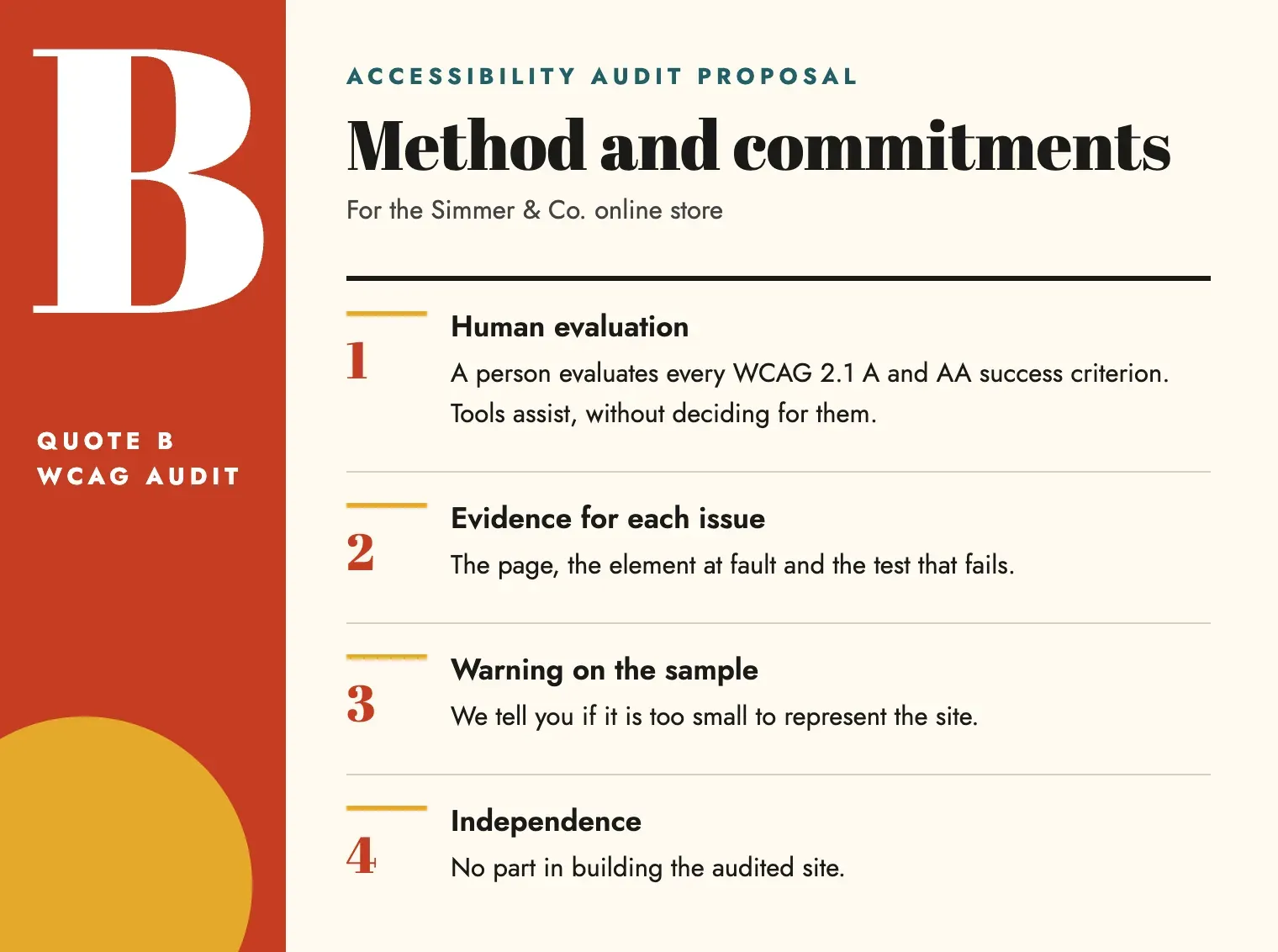
Ask the auditor to confirm at least these four points in writing:
- tests done by a person, with or without the help of tools;
- evidence for each issue: the page, the element at fault and the test that fails;
- a warning if the sample is too small to represent the site;
- an auditor who did not build the site, so the report has no stake in the code it judges.
Four signs should put you on guard:
- an "audit" run by a tool alone;
- an accessibility widget (a plugin that changes how the site looks) sold with the audit;
- a conformance result promised before any testing;
- the agency that built your site offering to audit it for your statement.
Send every auditor the same request, so you can compare the answers line by line. The template below makes each one spell out every point, from the sample to the auditor's independence.
Hello,
We would like an accessibility audit of our website against , so that we can .
The site: , about pages, built with , with . Main process: .
In your proposal, please specify:
- the sample of pages you suggest, and the processes tested end to end;
- the number of success criteria tested, and which ones a person evaluates;
- the test setup: screen readers, browsers, mobile;
- the deliverables: report, results for each success criterion, evidence for each issue, draft accessibility statement or ACR;
- the price and terms of the re-audit after fixes;
- the timeline, and the access or information you will need;
- the people who will carry out the audit, and any part your company played in building the site.
Please reply by .
Best regards,
10 fields to fill
 Forgotten Accessibility in Specifications: Who Pays the Bill?
#How to compare accessibility audit quotes?
Get a quote from at least two auditors. Then record the answers in a table: one column per auditor, one row per point of your request.
Read that table in this order: the pages and criteria tested, then the deliverables and the re-audit, and the price last. Price comes last because two quotes only compare when they test the same thing.
The two answers Simmer & Co. received show why.
| Line | Quote A | Quote B |
|---|---|---|
| Price before tax | €1,400 | €4,600 |
| Sample | 5 pages: home, product list, product page, cart, contact | The 17 pages and the PDF manual from the sample above |
| Checkout tested end to end | No: it stops at the cart | Yes: cart, shipping, payment, confirmation |
| Criteria tested | Not stated | Every WCAG 2.1 Level A and AA success criterion |
| Manual tests and screen readers | Automated scan and a quick review | NVDA and JAWS with Firefox, VoiceOver with Safari on desktop; TalkBack on Android, VoiceOver on iOS |
| Deliverables | A list of errors, with no result per criterion | Report with evidence for each issue, results per criterion, overall summary, draft statement |
| Re-audit | Not included | Fixed pages, €900 before tax |
| Timeline | One week | Three weeks |
| Auditors and independence | Not stated | A second auditor reviews the report; no part in building the site |
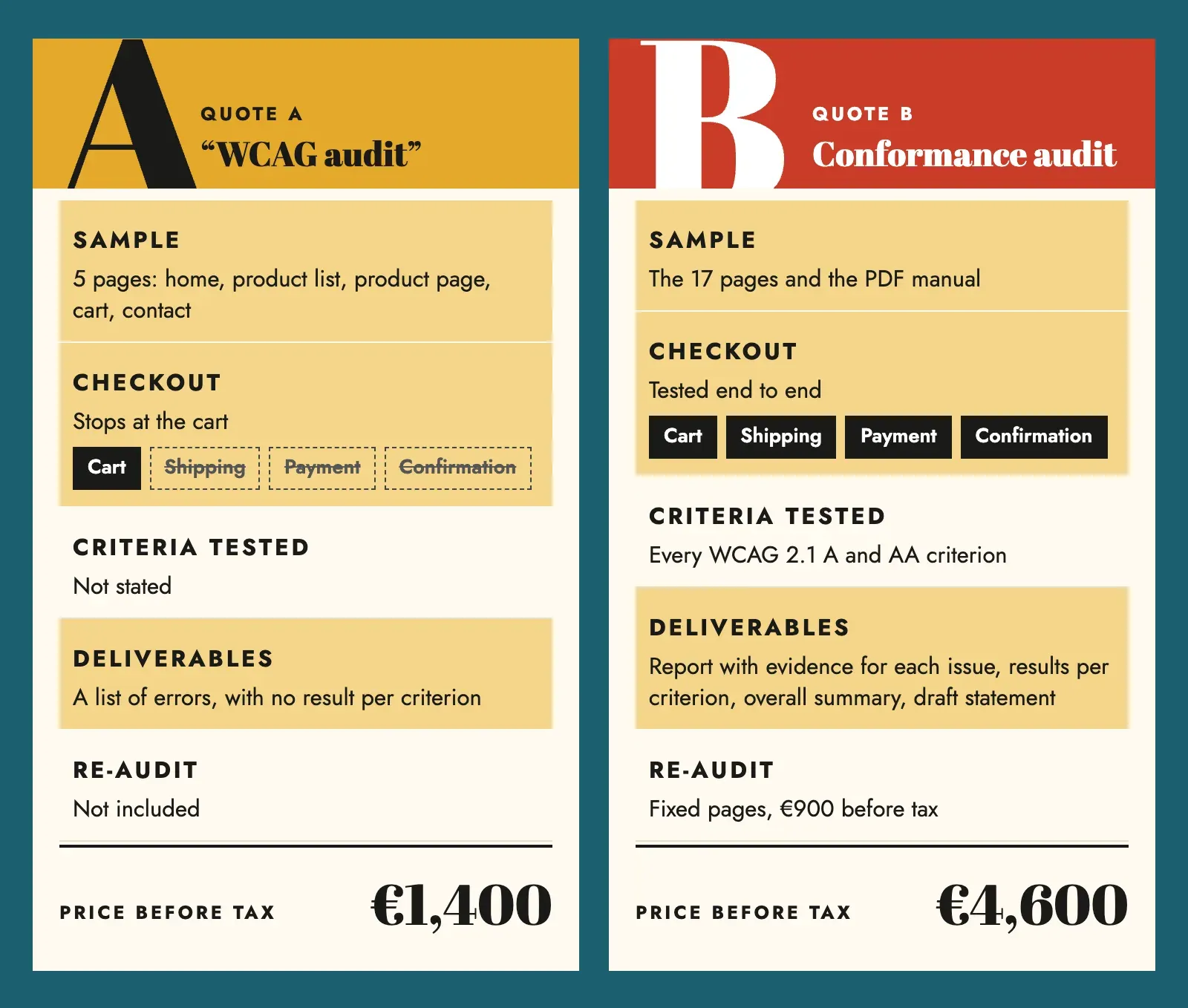
Quote A is a quick review sold as a full audit: it stops at the cart and gives no result per criterion. It still works as a first step, though only quote B delivers results you can publish, with the evidence. Before signing, ask a third auditor for a quote that tests the same scope.
Why. Quote A costs less mainly because it tests less: the sample tells you what you are buying. For your own quotes, reuse the row labels in the first column of the table, one by one.
Before you send your request, scan the pages in your sample and fix what a tool can find. The auditor will then report what a tool can't judge alone, like the Filters menu that won't open from the keyboard. If you want one more quote to compare, Includdy also runs WCAG audits, and the same request is all it takes to get ours.