
ADA website compliance audit: what it checks and how long it takes


The ADA sets precise measurements for a store's ramps, and none for its website. An ADA website compliance audit fills that gap with WCAG, the web accessibility guidelines the Justice Department points businesses to and has written into its website settlements. A person tests sampled pages and the whole booking or checkout path with a keyboard, zoom and automated tools, and writes up each barrier with its fix.
From the standard to the calendar
#What an ADA website compliance audit checks?
An ADA website compliance audit has a person check a sample of the site's pages against WCAG, the web accessibility guidelines, helped by automated tools. The version is 2.1 at Level AA, the one the Justice Department's website settlements of 2021 to 2024 name. The person uses the site as its visitors do: by keyboard, like people whose disability affects their grip, and zoomed in, like people with a vision disability. In the Justice Department's vaccine-booking cases, keyboard users could not select open appointment times.
Why WCAG, when no Justice Department regulation sets detailed web standards for businesses? The department's guidance says the ADA still obliges a business open to the public to make its online services accessible. The business picks the method, with WCAG and the federal Section 508 Standards as helpful guidance.
An "ADA audit" can also mean a building inspection. There the rules have numbers: the 2010 ADA Standards for Accessible Design cap ramps in new buildings at a 1:12 slope. In California, the state certifies access inspectors, called Certified Access Specialists.
Brittlebush Physical Therapy, our demo clinic in Tucson, Arizona, takes online bookings through a scheduling widget run by another company, Halvorsen Scheduling. Brittlebush's auditor tested seven clinic pages and the three booking screens, ten views in all. Our guide to website accessibility audits shows how to pick such a sample.
 Marker 1. The Standard line: every Level A and AA success criterion of WCAG 2.1. Marker 2. The Sample line: seven clinic pages and the three Halvorsen booking screens. Marker 3. The Testing line: an automated scan, then the keyboard alone, zoom to 200% and 400%, and the NVDA screen reader with Firefox.
#What Justice Department settlements add to the audit?
Where the Justice Department spelled out an audit, it asked for more than a scan. Springfield Clinic, an Illinois clinic, settled in 2024 after a complaint that its patient and records portals did not work with screen readers. Within three months, it had to retain an independent consultant approved by the United States, whose written evaluation would include recommendations for every area that did not conform.
In 2022, Kroger and CVS agreed to more, on vaccine content only. Their consultants would run "both automated and manual testing", and every 30 days, people who are blind, have low vision or have difficulty using a mouse would test it too. Kroger could skip a month with no content changes, and its consultant would set the testers' selection criteria.
Springfield Clinic's agreement has no such clause. In its audit method, the W3C, which publishes the guidelines, "strongly" recommends involving real people with a wide range of abilities, without requiring it. So ask the auditor for every Level A and AA criterion of WCAG 2.1, your booking process tested end to end. Add manual testing with the keyboard alone and at 400% zoom, and say whether you want testing by people with disabilities. Also require a recommended fix for each failure, a re-test once the fixes are in, and an auditor independent of the people who built the site.
 Website accessibility audit: cost, quotes and how to choose an auditor
#How an ADA audit tests online booking with a keyboard and zoom?
An ADA audit follows a booking from the first screen to the confirmation, once with the keyboard alone and once zoomed to 400%. The W3C's method samples every page of a complete process, so a store's checkout gets the same treatment.
#What happens with the keyboard alone?
People who rely on the keyboard include, the W3C notes, people who are blind and people with physical disabilities. On Brittlebush's own pages, we pressed Tab through the logo and the menu in order, each link outlined in marigold. At the sixth press, the focus, where key presses land, entered Halvorsen's calendar and never came out.
The first press lands on the clinic's logo, and the next four on the menu links.
The sixth press enters the calendar on Monday, November 9, the first open day.
Fourteen presses later, the focus is on Monday, November 30, the fifteenth open day.
The next press goes back to November 9, past the time slots and the Next button.
Backwards, the loop jumps from November 9 to November 30.
Escape does nothing: the booking can't go on without a mouse.
That loop is a keyboard trap, and it fails the Level A requirement No Keyboard Trap. Focus that moves into a component must be able to leave it with the keyboard alone. When that takes more than Tab, the arrow keys or another standard way out, the page must say how.
In the W3C's example of a calendar that passes, people tab through it and out, so the press to watch is the one after the last day. An auditor tries Esc too, a commonly used way out on a physical keyboard. On CVS's vaccine portal, the Justice Department's agreement describes people without a mouse "stuck in the control."
#What happens zoomed to 400%?
People with vision disabilities zoom the page to read. The Reflow requirement, at Level AA, asks that content keep working without two-way scrolling at a width of 320 CSS pixels, what a 1280-pixel window shows at 400%. Layouts that need two dimensions, such as data tables, are exempt, so the finding rests on Halvorsen's form and never on its month grid.
Brittlebush's page folds into one column. Halvorsen's "Your details" screen keeps its 640-pixel frame, twice the window's width, which leaves the date of birth, the email and the "Confirm appointment" button off-screen.
 Marker 1. The clinic's heading and introduction, inside the window. Marker 2. The part of the Halvorsen form that fits the window: the left column of fields, cut at the right edge.
#Does a vendor's widget belong in an ADA audit?
It has to. Without Halvorsen's three screens, Brittlebush's report would have come back clean while no keyboard user could book. With them, "Book a visit" fails: the audit judges the page the patient uses, whoever wrote each part. The W3C's audit method counts third-party content used within the site. WCAG itself requires all content on a page to meet No Keyboard Trap, since content that does not "can interfere with a user's ability to use the whole page."
| Test | Where | What happens |
|---|---|---|
| Keyboard alone | Halvorsen calendar | Focus cycles through 15 days, never leaves |
| Zoom to 400% | Halvorsen "Your details" | 640-pixel frame, "Confirm appointment" off-screen |
| Test | Where | What happens |
|---|---|---|
| Keyboard alone | Header, "Book a visit" page | Every link in order, outline visible |
| Zoom to 400% | Clinic's header and text | One column, no sideways scrolling |
The Justice Department applied the same logic to Springfield Clinic. Its agreement covered the portals two contractors ran day to day, and the clinic had to monitor them. The department's review had found 19 barriers, among them limited keyboard or screen reader accessibility. Brittlebush sends both findings to Halvorsen, each with its page, requirement and fix.
 WordPress accessibility audit: where each issue comes from, and who fixes it
#How long an ADA website audit takes?
Testing itself takes hours. A worked example on section508.gov, the federal accessibility site, assumes about one hour per page for a skilled tester. For Brittlebush's ten views, we estimate about ten hours, more for the booking. The W3C says booking platforms typically need more time and effort.
The report takes weeks. No US rule sets that time, so we use Defra's figure: the UK's environment department counts two to four weeks for a typical audit. The Justice Department's deadlines ran longer. In Champaign-Urbana's transit agreement and Springfield Clinic's, the evaluation was due four to six months after signing, and the fixes 60 days later.
The re-test is quicker. UK government guidance says a re-audit normally takes about half the time of the original, so one to two weeks for Brittlebush. Springfield Clinic then had to report to the department yearly for two years. A later audit under the W3C's method swaps about half the sample for fresh pages.
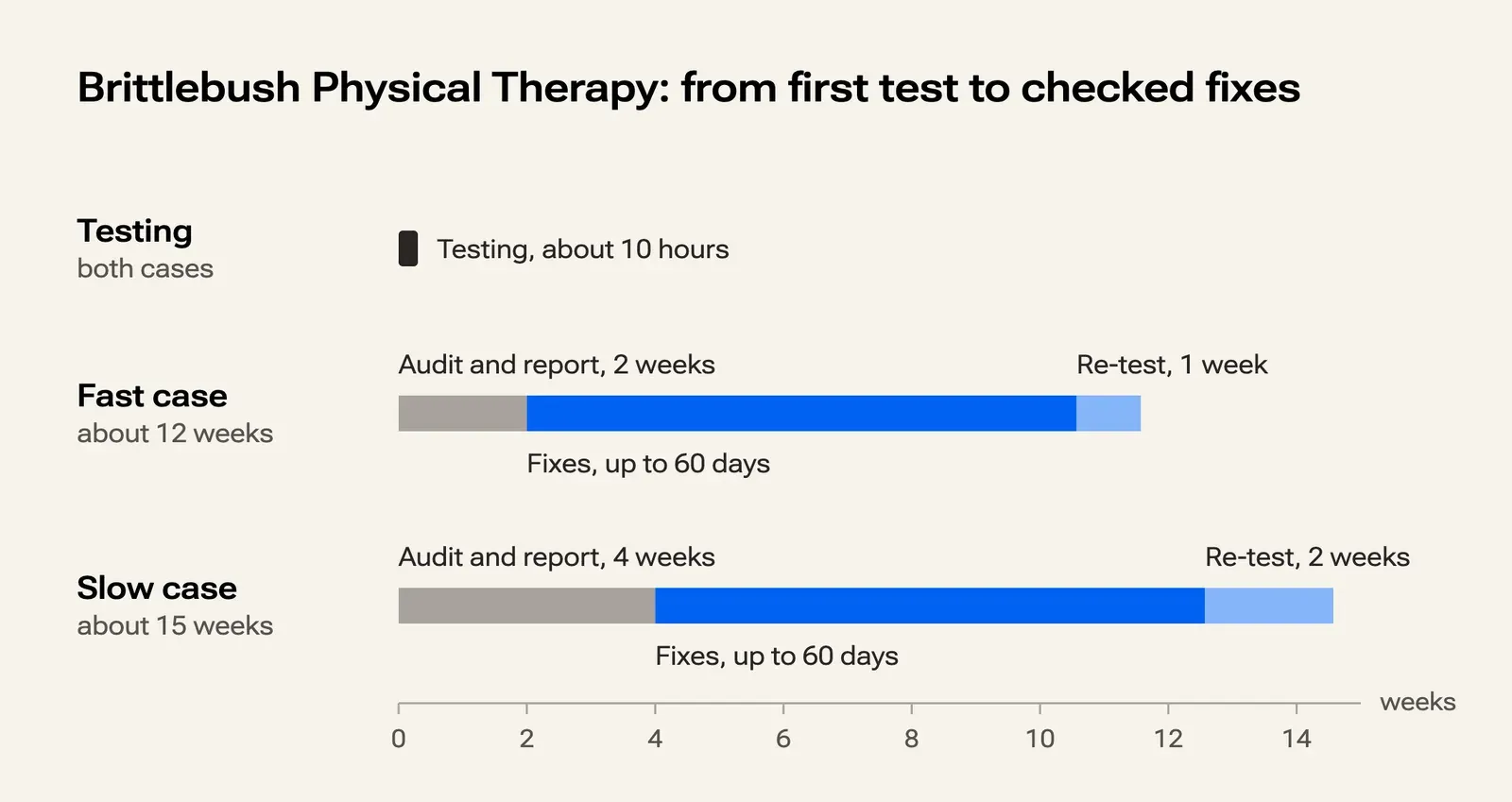
For Brittlebush, ten hours of testing sit inside about three months. The keyboard trap stays live until Halvorsen's fix, its lost bookings unseen by the clinic: a patient stuck in the calendar never reaches Next, so no request arrives. On day one, the clinic adds "Call us to book" above Halvorsen's calendar. The re-test then replays the booking by keyboard and at 400% zoom.
Includdy scans each page of the sample and lists its non-conformities, each with a test plan anyone on the team can replay. The team clears what a scan finds before the auditor's paid hours, then replays those tests during the fixes.