
WCAG vs EAA: what each one does, and which one is mandatory for an online store


The European Accessibility Act, the EU law that applies to online stores selling to consumers, never mentions WCAG, the international web accessibility rules. It asks for websites that are “perceivable, operable, understandable and robust”: the names of WCAG's four principles. In practice, a store measures its site against WCAG and checks the extra requirements of the European standard EN 301 549 separately.
From the law to the test
#What is the difference between WCAG and the EAA?
WCAG is the international rulebook for accessible websites, written by the W3C, the body behind web standards. Its criteria come in three levels, from A, the most basic, to AAA, the most demanding.
The European Accessibility Act (EAA) is an EU law that requires businesses to make some of their products and services accessible. Accessibility means that people can use a site despite a visual, hearing, motor, cognitive or speech disability.
One button at Ardley Candle Works, a candle maker that sells online, shows how these texts fit together.
 Marker 1. The “Add to cart” button, whose hidden name is “Buy the Fig Tree candle”.
#Which one is mandatory for an online store?
Every EU country had to write the EAA into its own law. Since June 28, 2025, it has applied to e-commerce services, the Act's term for selling online to consumers. A microenterprise is exempt: fewer than 10 people, and an annual turnover or balance sheet total of €2 million or less. With its 14 employees, Ardley is not one.
The Act's requirements for services never name a standard. Its Annex I asks for websites that are “perceivable, operable, understandable and robust”: the names of WCAG's four principles. The rule that Ardley's button breaks is filed under “operable.” Between the law and WCAG sits EN 301 549, a European standard that businesses can choose to follow. For the web, it includes every WCAG criterion at levels A and AA.
#How WCAG and EN 301 549 judge the same button?
Someone who can't hold a mouse, because of a motor disability or an arm in a cast, can run a Mac by voice with Voice Control, Apple's voice command feature. They say “Click Add to cart,” and the command fails: the words they speak are not part of the button's name. Each purchase then takes a detour, like showing numbers or a grid on screen and saying a number.
We read that name, “Buy the Fig Tree candle,” in Chrome's accessibility tree, the page as Chrome describes it to assistive software. Its developer tools show it in the Accessibility pane. The name comes from the button's aria-label attribute, a hidden label that replaces the visible text as its accessible name.
WCAG fails this button on Label in Name, a level A criterion that requires the accessible name to contain the visible text. EN 301 549 fails it too, because its clause on this point requires meeting that WCAG criterion.
| Text | Role for the store | On the button |
|---|---|---|
| European Accessibility Act | Binds the store | A website that is “operable” |
| EN 301 549 standard | A voluntary way to meet the law | Clause 9.2.5.3: meet the WCAG criterion |
| WCAG | Sets the rule | Criterion 2.5.3, level A: the name contains the visible text |
We show the fix on another button in our article on the aria-label attribute.
 The aria-label attribute: when to use it and how to word it
#Is a WCAG audit enough for EAA compliance?
A WCAG audit alone is not enough. For web pages, it covers only the part of the European standard EN 301 549 that comes from WCAG. It leaves out respecting the user's text-size and contrast preferences, documentation and support services, the requirements for video, voice and real-time communication, and the Act's duty to describe in writing how the service meets the accessibility requirements. Ardley's audit goes through the 50 criteria of WCAG 2.1 at levels A and AA. Meeting them means meeting every web requirement that the 2021 version of the standard takes from WCAG.
#What the audit leaves out?
For that 2021 version, the one officially recognized for public sector sites, the European Commission's table lists each requirement that goes beyond WCAG, along with the case where it applies.
Two families of requirements apply to every web page. The first is respecting the user's preferences, such as the text size or contrast set in their browser. The second covers documentation and support services. Others depend on what the site does, such as video, voice or real-time communication, and downloadable documents.
The EAA also adds non-technical obligations, like explaining to the public, in writing and orally, how the service meets the accessibility requirements.
 Marker 1. The Guidelines line: WCAG 2.1, level AA, the 50 success criteria at levels A and AA. Marker 2. The issue under criterion 2.5.3: the “Add to cart” button, named “Buy the Fig Tree candle”. Marker 3. The “Outside the scope of this audit” box: the EN 301 549 requirements that go beyond WCAG.
#What a national authority would look at?
Under the Act, every EU country names authorities that check services and follow up complaints. What Ardley can show them is the information the Act asks it to put in its terms and conditions, or an equivalent document. That information includes a description of how its service meets the accessibility requirements that apply.
For the WCAG part, the audit report is where that description starts. The standard's other requirements that apply to the site complete it.
 Website accessibility audit: cost, quotes and how to choose an auditor
#WCAG 2.1 or 2.2: which version to ask for in the audit
Ask for an audit against WCAG 2.2 at level AA, and have the six criteria that version added up to that level reported separately. On the legal side, presumption of conformity works like this: once the EU cites a version of EN 301 549 in its Official Journal under the Act, a service that meets that version is presumed to meet the Act's accessibility requirements it covers. Until then, following the standard is voluntary and proves nothing by itself.
The European Commission's list of cited standards includes no version of EN 301 549 under the Act. Ireland's National Disability Authority expects the new version, aligned with WCAG 2.2, to be cited on December 16, 2026. The Commission has given no date.
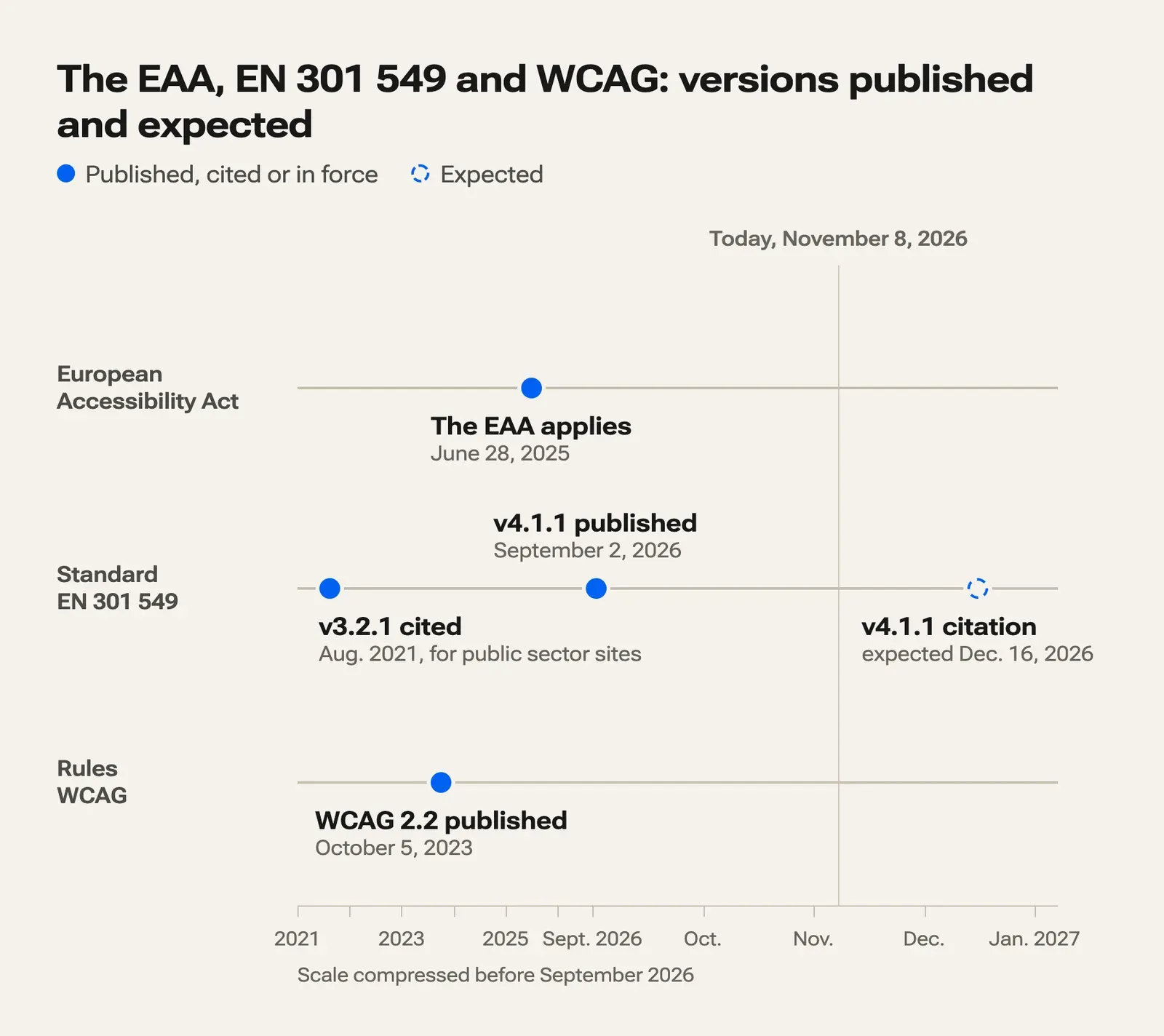
| Date | What happens |
|---|---|
| August 2021 | Version 3.2.1 of the standard cited, for public sector sites |
| October 5, 2023 | WCAG 2.2 published |
| June 28, 2025 | The Act starts to apply to online stores |
| September 2, 2026 | Version 4.1.1 published, aligned with WCAG 2.2 |
| November 8, 2026 | No standard cited under the Act |
| December 16, 2026 | Citation of version 4.1.1 expected, according to Ireland's disability authority |
#What WCAG 2.2 changes?
The W3C recommends the latest version of WCAG without withdrawing the previous one. WCAG 2.2 adds six criteria at levels A and AA, and the new version of the standard is aligned with it. Reported separately, those six measure a store against what the new standard adds from WCAG, while its citation is pending.
 EN 301 549 v4.1.1: what the new version changes for your website
#The question to ask the agency
Before signing a quote for its next audit, Ardley asks the agency in writing which guidelines and version the audit follows, and at what level. It also asks whether the six criteria added in WCAG 2.2 are reported separately, and which EN 301 549 requirements it doesn't cover.
Whatever the answer, Ardley's button fails. The criterion it breaks appears in both versions of WCAG and of the standard. For an online store, the gap between the two WCAG versions comes down to six criteria.
To see where its whole shopping journey stands, a store like Ardley can have Includdy audit its site against the RGAA, the French method that tests WCAG 2.1. These questions also work as a quote request to us.