
European Accessibility Act: who it applies to, and when a small business is exempt

An online store with fewer than 10 people can bring in more than €2 million a year and still be exempt from the European Accessibility Act. This EU directive requires businesses that sell online to consumers to make their sites accessible to people with disabilities. It exempts those with fewer than 10 people when their annual turnover or balance sheet total is €2 million or less. Either one is enough.
The site first, then the size
#Which e-commerce sites the European Accessibility Act covers?
The European Accessibility Act (EAA) covers a closed list of products and services. For a business that sells online, the one that counts is e-commerce: selling at a distance, on a website or an app, "with a view to concluding a consumer contract".
Making e-commerce accessible means a person with a disability can get all the way to payment like anyone else, for example someone with low vision who enlarges the text. For online shops, the directive's annex asks for identification methods, electronic signatures and payment services that are "perceivable, operable, understandable and robust".
The test comes down to one question, then: can a consumer buy or order on the site? What it sells makes no difference, because the directive applies to the online sale "of any product or service". A bag of coffee is enough.
Take Halloway Roastery, a coffee roaster in Cork. It supplies coffee shops and restaurants outside its website, and sells to consumers through its online shop. In its cart, a customer checks out two bags of Ethiopian Mocha at €9.80 each. That is a contract concluded at a distance, and the site falls under the Act.
 Marker 1. The cart line: Ethiopian Mocha, 250 g, quantity 2, €9.80 each, €19.60 in total. Marker 2. The Check out button, below the €19.60 total.
#B2B sites and sites that don't sell online
The directive calls a private shopper a consumer: someone who buys for purposes outside their trade, business, craft or profession. A site that sells only to coffee shops and restaurants would therefore sell to no consumer and stay outside the Act, as long as no consumer can open an account or check out on it. That is how Germany's federal accessibility agency reads the definition.
By the same reading, a site that only presents the business, with a plain contact form, would be outside the Act too. Two cases are less clear-cut. A quote request form already prepares a contract, which leaves room for doubt. Online appointment booking is more likely covered: Germany's labor ministry and the Dutch consumer authority (ACM) both count it as e-commerce.
#Which businesses are exempt from the European Accessibility Act?
The directive exempts a service business, online shop included, with fewer than 10 people and an annual turnover or balance sheet total of at most €2 million. It calls this business a microenterprise and exempts it from the accessibility requirements and from every obligation tied to them. One of the two amounts is enough, since the directive says "or".
That "or" is missing from the summary on Your Europe, the EU's official portal for businesses, which only mentions turnover. Ireland's enforcement authority, the CCPC, gives the full definition, balance sheet total included.
#Which figures to use?
For the numbers, the directive points to the EU recommendation that defines small and medium-sized enterprises. That recommendation uses the figures of the latest approved accounting period, meaning the last closed financial year, with turnover excluding VAT. The balance sheet total is the figure at the bottom of the balance sheet (total assets). The directive counts "persons", and the recommendation includes the owner-manager, along with partners who work regularly in the business and benefit financially from it. Apprentices don't count.
#Is Halloway Roastery exempt?
We ran the roastery's figures through the directive in order, for the financial year ended June 30, 2026. With seven people, it stays under 10. Its turnover of €2.3 million is over €2 million. Its balance sheet total, €1.2 million, stays under, and that is enough: Halloway Roastery is a microenterprise, exempt even though its site sells online.
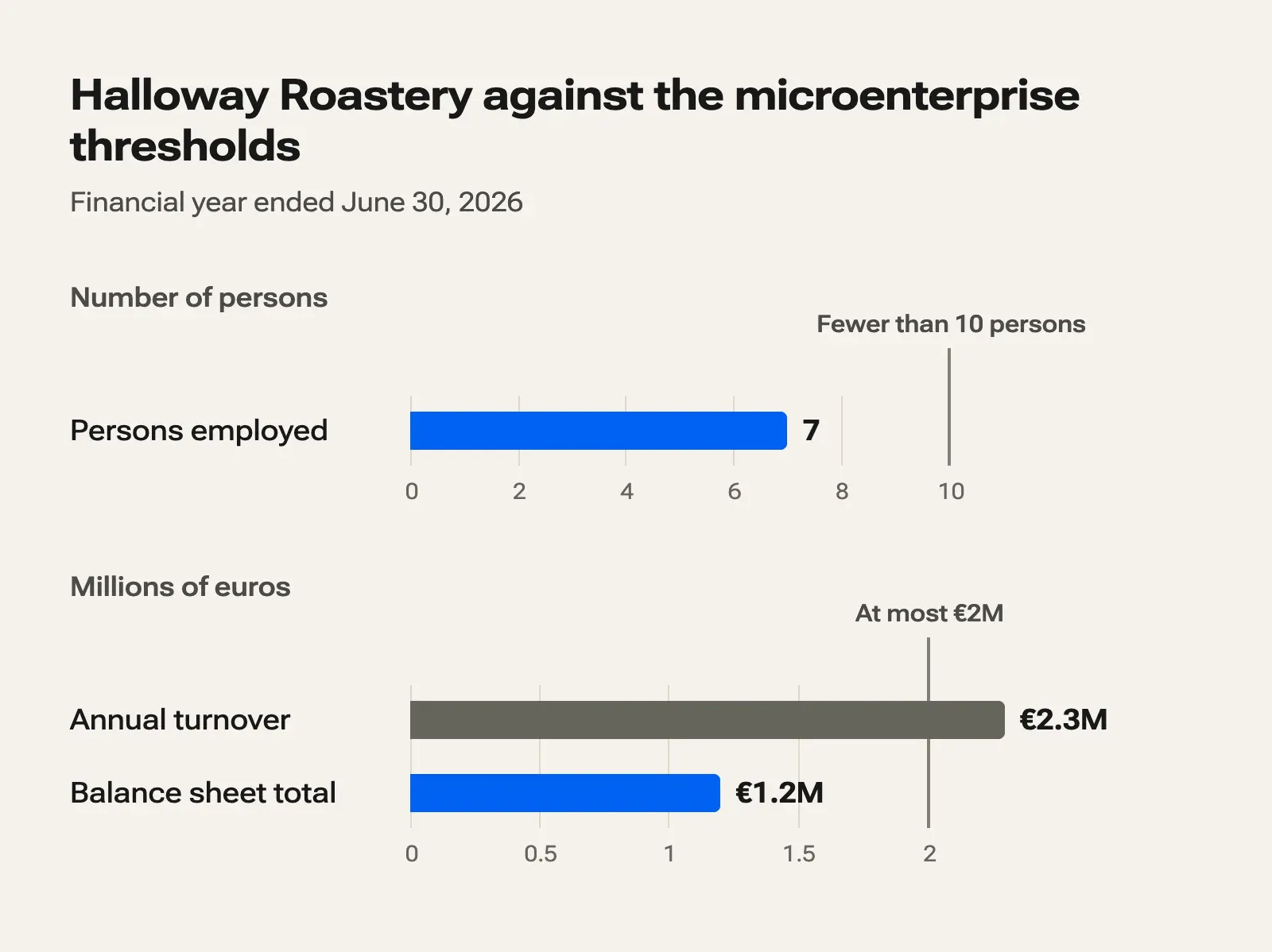
| Criterion | Halloway Roastery | Ceiling in the directive |
|---|---|---|
| Persons employed | 7 | Fewer than 10 |
| Annual turnover | €2.3M | €2M at most |
| Balance sheet total | €1.2M | €2M at most |
Another roaster with seven people, whose turnover and balance sheet total both exceed €2 million year after year, is not a microenterprise: its site falls under the Act.
#What to do when the Act applies, and when the business is exempt?
A business the Act covers starts with the pages where the consumer signs in and pays. An exempt microenterprise has nothing to file, and keeps a note of its figures.
#Which pages to start with when the Act applies?
The directive's annex names identification, security and payment, so the account login, the cart and the payment page come first. The rest of the site follows, since the same annex asks for the website itself to be accessible.
For a first test, zoom in on the page the way someone with low vision does to read. WCAG, the international guidelines for web accessibility, sets three levels of requirements. From level AA, the second, text must be able to grow to 200% with the browser alone, with no content or function lost (captions and images of text excepted). EN 301 549, the European accessibility standard, asks the same of every web page.
We zoomed Halloway Roastery's payment page to 200% in a window 1,280 pixels wide. It switches to a single column with no horizontal scrolling, and the Pay €19.60 button stays whole.
 Marker 1. The Pay €19.60 button, whole, across the full width. Marker 2. The order summary, moved below the card form.
WCAG goes beyond 200% at the same level. At 400% in that window, the page is only 320 pixels wide. WCAG then asks that it reads top to bottom without sideways scrolling, losing no information or function. Only content that needs a two-dimensional layout to be used or understood, like a map or a data table, is exempt. We ran the test again at 320 pixels: the page still fits in one column, with no horizontal scrolling, and nothing disappears.
 Website accessibility audit: cost, quotes and how to choose an auditor
#Does a microenterprise have to declare its exemption?
No. The directive exempts it from "any obligations relating to the compliance" with the requirements. Elsewhere, the directive asks a business that relies on one of its two exceptions, a disproportionate burden or a fundamental change to the service, to inform the authorities. Even that duty "shall not apply to microenterprises".
The EU's Your Europe portal can still mislead Halloway Roastery here. Its Exceptions section lists small service businesses. Right below, a paragraph says any business can claim a disproportionate burden, with evidence "reviewed every 5 years", which reads as if small businesses needed it too. That paragraph describes another route. The directive explains why it spares microenterprises: asking a service microenterprise even to assess the burden "would in itself constitute a disproportionate burden". The roastery has no burden to claim and no assessment to write.
Each EU country still has authorities that check services and follow up complaints. If a complaint about its checkout reaches one of them, the roastery answers with its figures. It keeps a dated note with its accounts: headcount, turnover excluding tax, balance sheet total, its conclusion and the articles of the directive it relies on. It redoes the note at every year-end, since the figures that count are those of the last approved year. Here the €1.2M balance sheet total, which the Your Europe summary leaves out, is what exempts it.
A roaster above both amounts, like any business the Act covers, can start with an Includdy scan of its cart, then of its payment page. The scan lists the accessibility failures on each page, a first list to work from before the full audit.