

Website accessibility statement: from the audit report to a published page


Your accessibility audit is done, and the accessibility statement is where you report it on your site: the compliance status, the content that doesn't work yet and how to report a problem. Public sector bodies in the EU and US federal agencies must publish one; for most other organizations it is good practice. We follow a local council from the audit report to the reply to a resident.
From the audit score to the reply to a resident
#Does your website need an accessibility statement?
In the European Union, the Web Accessibility Directive requires public sector bodies to publish a statement on each website and mobile app, and to keep it up to date. Public sector bodies include national, regional and local authorities, bodies governed by public law and associations formed by them. Public broadcasters are excluded, and so are nonprofits whose services are neither essential to the public nor meant for people with disabilities.
In the United States, only federal agencies must publish one. OMB memo M-24-08 requires every agency to keep an accessibility statement on its websites, with known limitations, a feedback mechanism and instructions for filing a Section 508 complaint.
State and local governments fall under Title II of the ADA. The Justice Department's rule makes WCAG 2.1 Level AA the standard for their websites and apps. The deadline is April 26, 2027 for those with 50,000 residents or more, and a year later for the rest. The rule sets a technical bar and no statement format, and private businesses have no statement duty.
Our example, Rivermead Council, is a local council that runs waste collection, a recycling center and three daycare centers. As a local authority, it is a public sector body, so the directive applies to its site.
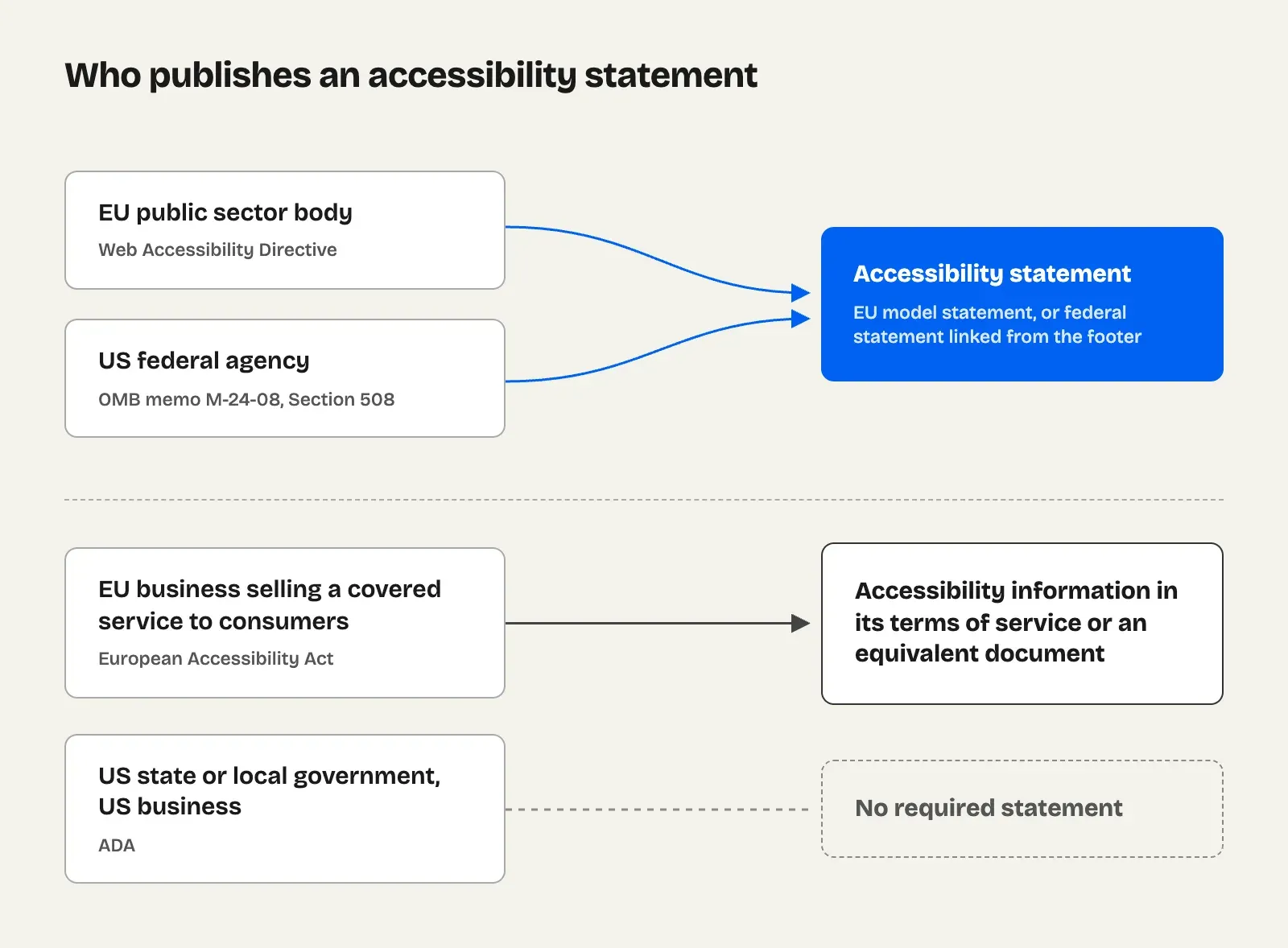
| Organization | What it publishes | Rule |
|---|---|---|
| EU public sector body | Accessibility statement on the EU model | Web Accessibility Directive |
| EU business selling a covered service to consumers | Accessibility information in its terms of service or an equivalent document | European Accessibility Act |
| US federal agency | Accessibility statement, linked from the footer | OMB memo M-24-08 |
| US state or local government, US business | No required statement | ADA |
#If you sell a service covered by the European Accessibility Act
A business selling consumers a service covered by the European Accessibility Act, such as an online store, publishes no statement. It makes the service accessible and describes how in its terms of service or an equivalent document, in written and oral form. Microenterprises are exempt from both duties: fewer than 10 people, and annual revenue or a balance sheet total of €2 million or less. See our guides on the EAA for businesses and the EN 301 549 standard.
Rivermead Council sells nothing online, so the EAA doesn't reach it.
#If your site falls under French law
France applies the directive through the RGAA, its national standard, and goes further. The statement is also required for companies with more than €250 million in revenue in France. It copies the official French template word for word, and the status follows a percentage: fully compliant at 100% of criteria met, partially compliant from 50%. Our article on the next version of the RGAA explains how the French statement is changing.
#Fully, partially or not compliant: which status to declare
The EU model statement offers three statuses. Fully compliant means every requirement is met without exceptions. Partially compliant means most requirements are met, with some exceptions. Not compliant means most requirements are not met.
The status rests on an actual evaluation of a sample of pages, done by your own team or by a third party, and the statement names the method. A criterion is applicable when it concerns at least one page in the sample, and passed only when it fails on none of them. The share of passed criteria among applicable ones decides between "most" and "few."
#How Rivermead Council reads its audit report?
For Rivermead Council, the firm Edgewood Audit Group delivered its report on September 25, 2026. Across the 17 pages in the sample, 54 criteria apply and 33 pass on every page: 61.1%. The average page score reaches 83%, but the status follows the 61.1%: a majority of requirements met, with exceptions, so "partially compliant."
Why. A defect on one of the seventeen pages removes a whole criterion from the 61.1%. In the average, the same defect only lowers the score of its own page, one score out of seventeen.
Avoid
 Marker 1. The 83% compliance figure shown large, an average page score.
Correct
 Marker 1. The line stating that 61.1% of criteria are met.
Without a valid evaluation, the honest status in the W3C statement generator is "Not assessed" until the audit is done.
 Website accessibility audit: cost, quotes and how to choose an auditor
#How to write an accessibility statement with the EU model?
Start from the model statement and replace only its bracketed text. Its mandatory sections come in this order: Compliance status, Non-accessible content, Preparation of this accessibility statement, Feedback and contact information, and Enforcement procedure. Keep each heading as it is: people who have read one statement know where to look in the next. Some countries add their own mandatory content on top of the model.
Some brackets, such as the contact details, have nothing to do with the audit. Optional sections, such as planned fixes, can follow.
#Which subsection each non-accessible item goes under?
Non-accessible content has three subsections. Non-compliance holds what still needs fixing, and disproportionate burden what would cost too much to fix. What the law leaves out goes under content not within the scope of the applicable legislation. Each can point to an accessible alternative.
For Rivermead Council, we sorted six items one by one.
 Marker 1. The non-compliance subsection. Marker 2. The disproportionate burden subsection. Marker 3. The subsection for content not within the scope of the applicable legislation.
Why. The subsection tells people what to expect: a fix on the way, a temporary exemption, or no requirement at all.
#What goes under non-compliance, and how to describe it?
Non-compliance covers content that still needs fixing: neither out of scope nor covered by a disproportionate burden claim. Describe each item in non-technical terms, as the model asks; the W3C suggests "videos do not have captions" for a failed captions criterion. Say what people can't do, how to get the content another way and when the fix will come. The criterion number can follow.
On the Rivermead Council site, the daycare preregistration form, built by the council itself, goes under non-compliance. Its error messages aren't tied to their fields: with a screen reader, which reads the screen aloud or in braille, you can't tell which answer to correct. The 2027 waste collection calendar, published as an image, goes there too. The council produced it in 2026, so no exemption covers it.
Why. The description tells people, before they try, whether the service will work for them.
#When to claim a disproportionate burden?
A disproportionate burden is claimed item by item, for a limited time. The directive weighs the organization's size, resources and nature, and the cost of the fix against the benefit for people with disabilities, given how much the content is used. Lack of priority, time or knowledge is not a legitimate reason. The statement explains which requirements can't be met and, where appropriate, offers an accessible alternative.
On the Rivermead Council site, the "Sort Smart" game, launched in 2017 and still online, can't be played with a keyboard or a screen reader. Its questions were updated after September 23, 2019, so the archive exemption doesn't cover it. Rebuilding it would cost about €18,000 for 300 games a year, and a replacement comes in the fall of 2027. Until then, the council claims a disproportionate burden and point to the sorting guide web page.
#What content is out of scope?
The directive lists the exemptions. Live audio and video are exempt; a recording kept online counts as pre-recorded media, normally within 14 days. A map meant for finding your way is exempt only if its essential information is also available in an accessible digital form. An archive is exempt if no active administrative process needs it and nobody has updated it since September 23, 2019.
The live stream of the Rivermead Council meetings goes under content not within scope, since live video is exempt. The replays posted the next day still have to be accessible. The map of glass and paper drop-off points goes in the same subsection, because a table under the map lists the address of each point.
#Is a module bought from a vendor out of scope?
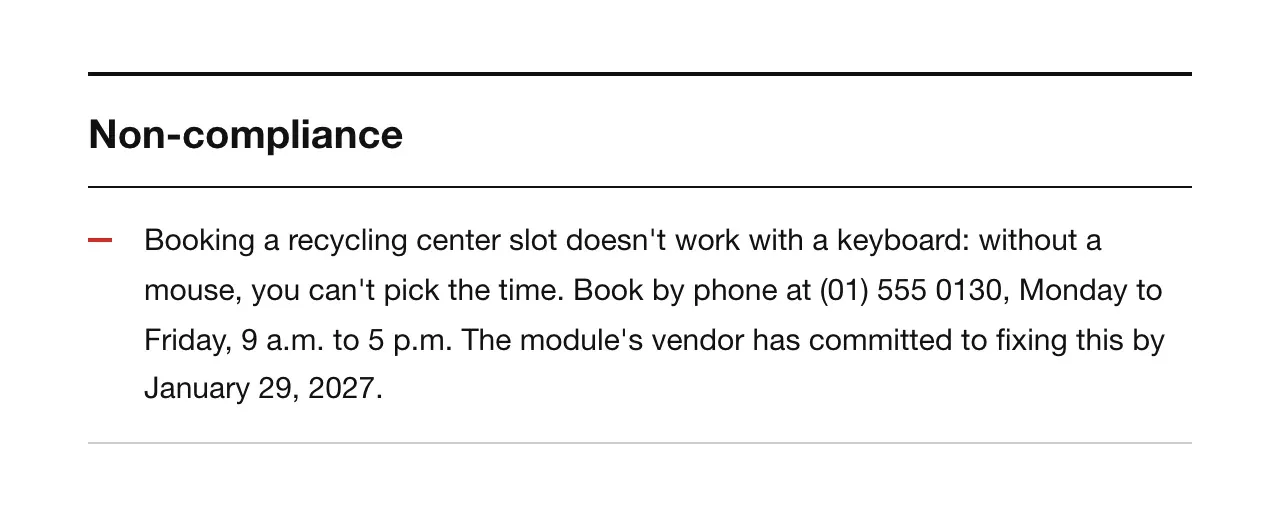
Third-party content is out of scope only if the organization neither funds it, develops it nor controls it. A module you pay a vendor for is funded by you, so as a rule it goes under non-compliance, unless a disproportionate burden claim covers it.
On the Rivermead Council site, the recycling center booking module doesn't work with a keyboard: without a mouse, you can't pick a time slot. The council bought it from a vendor and so funded it, which puts it under non-compliance. The statement offers booking by phone at (01) 555 0130 until the fix the vendor promises for January 29, 2027.
Avoid
 Marker 1. The recycling center booking module, filed as content not within scope.
Correct
#What goes under preparation of this accessibility statement?
This section opens with the date the statement was prepared and the method: a self-assessment or an evaluation by a third party. The date of the last review follows. Rivermead Council adds the test environments from the audit report, such as the NVDA screen reader with Firefox, as the W3C advises.
#Where to put the accessibility statement on your website?
The model statement asks for an easy-to-find link: on the homepage, or on every page through a shared header or footer. A standard address may be used; Rivermead Council chose "/accessibility." Publish the statement on the site itself, in HTML: a scanned PDF is only a picture of the text.
US federal agencies have a stricter rule: the link sits in the sitewide footer, reads "Accessibility" or "Accessibility statement," and never hides behind a "Website policies" page.
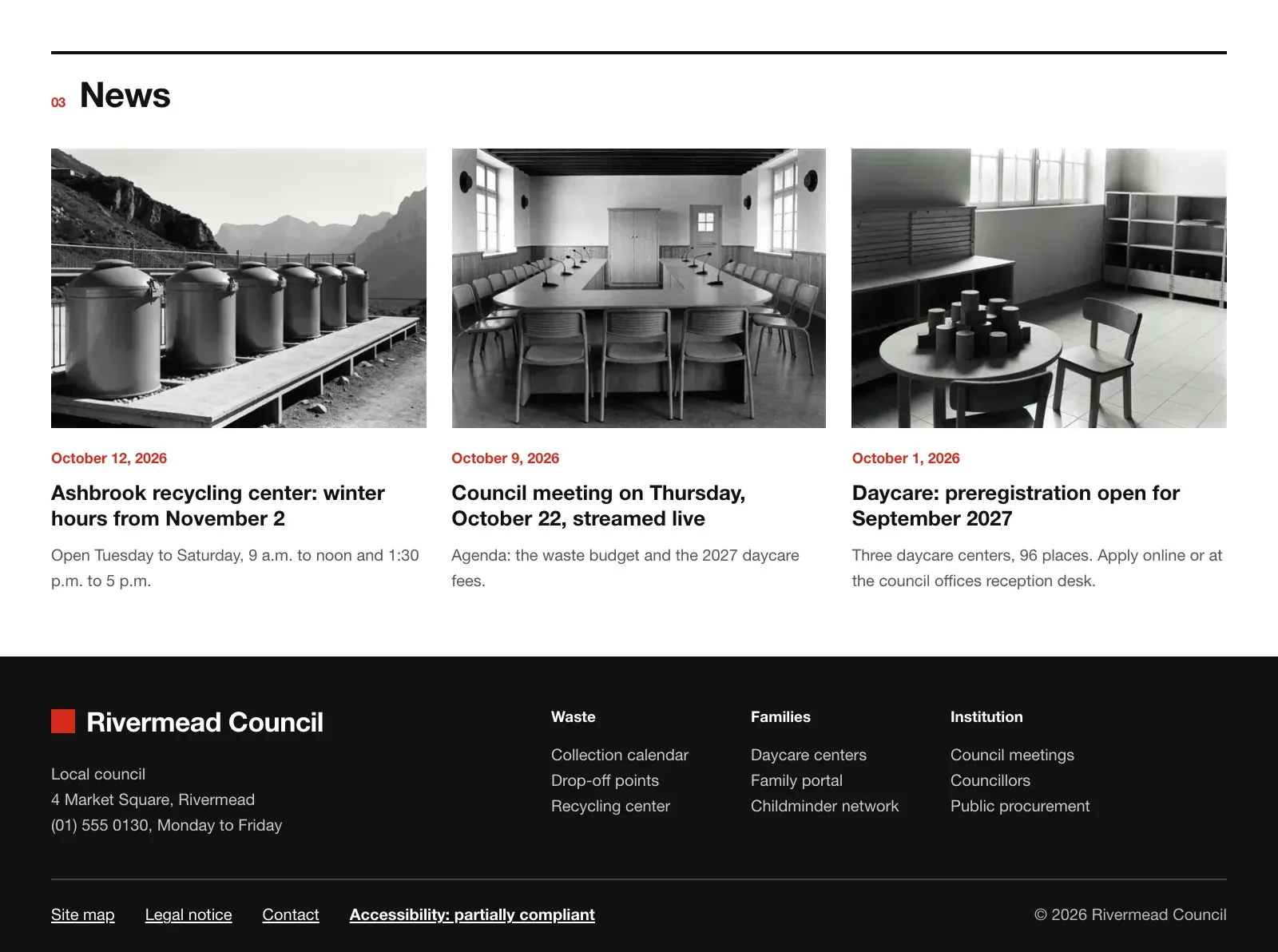
In the Rivermead Council footer, the link to the statement reads "Accessibility: partially compliant" and sits next to the site map and contact links. The EU model leaves the status in the link text optional, while French law requires it on the homepage.
#Where to publish the statement for a mobile app?
For a mobile app, the statement goes on the website of the body that developed the app, or alongside the information shown when people download it. It may also be available from within the app.
#How to handle accessibility feedback and complaints?
The statement offers an accessible way to report a problem, such as an email address or a form. Under the directive, anyone can use it to flag a failure or ask for exempted content. The organization owes an adequate answer within a reasonable time, and the W3C advises stating the usual response time in the statement.
Rivermead Council acknowledges each report the day it arrives and answers within a week. Its form asks what the person couldn't do, on which page, and whether they want the content another way.
 Marker 1. The question asking whether the person wants this content or service another way, and its three answers.
#Which enforcement procedure to point people to?
If the answer doesn't solve the problem, the person can turn to the enforcement procedure that each EU country sets up, such as an ombudsman. The Enforcement procedure section describes it, links to it and gives the enforcement body's contact details. For a US federal agency, the statement explains how to file a Section 508 complaint and how that differs from the feedback form.
#What to write in the reply?
On Tuesday, October 13, 2026, Helen Marsh reported that she couldn't book a recycling center slot with her keyboard, and asked to book by phone. She got an acknowledgment that day. On Thursday, October 15, the Digital Services team replied with a Saturday slot booked for her. The reply restates the date of the report and names the team handling it, with its contact details. It gives the interim solution, here the booked slot, then the promised date for the permanent fix. It ends with the next step: if the answer doesn't solve the problem, the person can contact the enforcement body, as the Enforcement procedure section of the statement explains.
#How often to update an accessibility statement?
The directive asks for a statement that is regularly updated, and the decision that sets the model encourages a review at least once a year. After a substantial revision of the site, the model recommends a new evaluation and an updated statement. The W3C adds that a statement dated more than a year ago may look unmaintained.
US federal agencies show the date of the last update or review, and update the statement when the policies it describes change. Under French law, the statement is updated after a redesign, three years after its publication, or 18 months after a new version of the RGAA.
Rivermead Council prepared its statement on October 12, 2026. It will update it when the Family portal moves to its new platform, which counts as a substantial revision. Without that, the council reviews it by October 12, 2027.
 Marker 1. The sentence saying the statement was prepared on October 12, 2026.
#What to check before you publish or update the statement?
Before you publish, and at every update, check these eight points:
If your statement would have to say "Not assessed," or its yearly review is due, you need a full audit. Includdy carries out these audits: send it the quote request from our audit guide as written, and the report gives you the status to declare.