

WCAG 3.0: when will it be released, and should you prepare now?


A client who wants a “WCAG 3 compliant” site is asking for a text published ten times since 2021, always as a draft. WCAG 3 is the next version of the accessibility guidelines from the W3C, the body that sets web standards. It is not expected to be a finished standard for a few more years. The way to prepare is to aim for WCAG 2.2 at level AA.
From the W3C draft to EU law
#Is WCAG 3.0 official, and when will it be released?
WCAG 3 exists only as a Working Draft, the first of the three stages a W3C text goes through. No date has been set for the final version. These accessibility guidelines explain how to make a website usable by someone who is blind, deaf or unable to hold a mouse. The W3C renamed this version “W3C Accessibility Guidelines,” because it also covers apps, tools, publishing and emerging technologies.
#What does “Working Draft” mean for a W3C standard?
A Working Draft is published to collect feedback, and the W3C does not endorse its content. We counted ten entries in the official publication history, from January 2021 to September 2026, all of them Working Drafts. The W3C process has had three stages since its August 2025 revision.
 Marker 1. The “Status” column: nine “Working Draft” entries and one “First Public Working Draft,” no other stage.
| Stage | What it means | WCAG 3 |
|---|---|---|
| Working Draft | Published for feedback, no commitment | Ten publications |
| Candidate Recommendation | Complete text, changed only after implementation testing | Targeted for late 2027 |
| Recommendation | Final, approved text | No date |
The 2025 revision also dropped the “Proposed Recommendation” stage, so a source that still lists it is following the old rules.
#What release date has the W3C given?
None for the final version: the W3C only speaks of “a few years” before WCAG 3 becomes a standard. The only written schedule is in the proposed charter of the working group that writes WCAG, a document that sets what the group must deliver. It aims for at least a Candidate Recommendation Snapshot, a frozen version of the text, by late 2027. That snapshot has to cover the WCAG 2.2 success criteria and come with a method for judging conformance the group agrees on.
The minutes of the October 13, 2026 meeting put the snapshot at January 2028, a goal called “aggressive” in the same breath. The final publication process would begin a year later, and no official schedule includes those dates.
#What changes in the WCAG 3.0 draft?
The draft published on September 10, 2026 redefines conformance but leaves two things open: the tiers above conformance and the contrast measure.
#What happens to levels A, AA and AAA?
In WCAG 2, a site aims for an entire level, from A to AAA. The draft sets a single bar for conformance: meeting every core requirement. That bar is the third of six tiers that show a site's progress. Below it come two tiers: avoiding physical harm, then foundational access. Above it, bronze, silver and gold add supplemental requirements and assertions. With an assertion, a person or an organization formally states that they followed a given practice: testing the site with users, for example, or, for gold, training staff in accessibility.
 Marker 1. The Bronze, Silver and Gold rows, whose number of supplemental requirements and assertions is marked “TBD,” to be determined.
Even this structure may change. An editor's note describes another option, a progress score followed by bronze, silver and gold awarded after conformance, and asks the public to weigh in. A client who asks for “WCAG 3 Silver” is asking for a tier whose number of requirements is still “to be determined.”
#Does APCA replace the 4.5:1 contrast ratio?
No. The draft's contrast requirement has no threshold. Our search of the draft found no mention of APCA, a method that ties contrast to text size and font weight. The requirement's sentence ends on an empty placeholder, “@@[contrast measure to be determined],” and an editor's note says the contrast algorithm “is yet to be determined.”
 Marker 1. The requirement “Text contrast sufficient (minimum),” whose sentence ends with the empty placeholder “@@[contrast measure to be determined]”. Marker 2. The editor's note: “The contrast algorithm used in WCAG 3 is yet to be determined”.
The WCAG 2 ratio, 4.5:1 for body text, therefore remains the one that counts. Nothing in this draft can serve as a development target yet. An APCA score is for guidance only.
 How to check the contrast ratio of text in Chrome DevTools
#Should you prepare for WCAG 3.0 now, or stay on WCAG 2.2?
Stay on WCAG 2.2 and target level AA now. The W3C itself calls meeting this version's success criteria today the best way to prepare for WCAG 3, and warns that the current draft will change. The European standard EN 301 549 uses the same level for websites.
In practice, fix the failures a site has today against level AA. In our view, a test checklist for WCAG 3 is only worth building once the text is complete, at the Candidate Recommendation stage. Any promise of “WCAG 3 compliance” is a claim about an unfinished draft.
#When does a new WCAG version count under EU law?
A new WCAG version starts to count once it is part of a cited version of EN 301 549. Citing means the European Commission publishes the standard's reference in the Official Journal of the European Union. A product or service that follows a cited standard is then presumed to meet the requirements it covers.
Article 15 of Directive (EU) 2019/882, the European Accessibility Act, sets this out. The same presumption covers public sector websites and apps under the Web Accessibility Directive. The standard itself stays optional: it calls itself “one voluntary means” of meeting the Act.
The only cited version, v3.2.1, is built on WCAG 2.1 and was cited for the public sector alone. No version is cited for the Accessibility Act, so no standard gives businesses that presumption yet. To find the WCAG version that applies, check which version of the standard is cited, then which law covers the site.
#How long did earlier WCAG versions take to reach EU law?
We measured each wait: from six and a half months to more than three years.
- WCAG 2.1, final on June 5, 2018. EN 301 549 took it in almost at once, in August 2018. Its citation on December 21, 2018, gave public sector websites the presumption of conformity six and a half months after the final version.
- WCAG 2.2, final on October 5, 2023. Version 4.1.1 of the standard only came out on September 2, 2026, two years and eleven months later. It is still waiting to be cited, more than three years after the final version.
- WCAG 3. With no dated final version, the countdown has not started. Both earlier versions were final when the standard took them in; if the pattern holds, we expect six and a half months to more than three years after WCAG 3 is final.
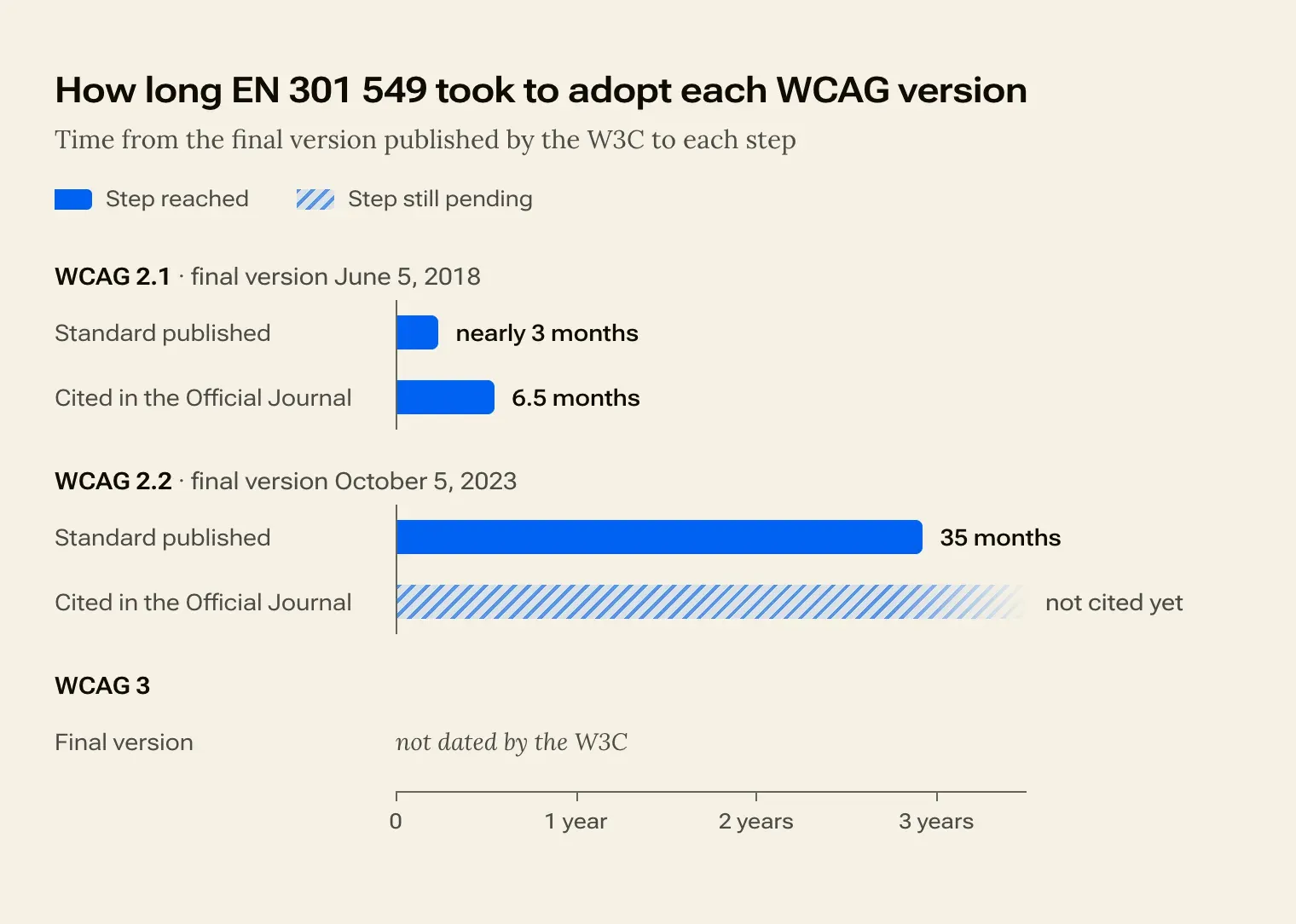
| Step | WCAG 2.1 (June 5, 2018) | WCAG 2.2 (October 5, 2023) |
|---|---|---|
| EN 301 549 published | August 2018 Nearly 3 months | September 2, 2026 2 years and 11 months |
| Standard cited in the Official Journal | December 21, 2018 6.5 months | Not cited yet |
The only cited standard still follows WCAG 2.1. A client who wants a “WCAG 3 compliant” site is therefore two versions ahead of it. The release of WCAG 3 will only open a second wait, for the standard to take it in. For the previous version, that wait has already lasted more than three years.
One target serves both waits: WCAG 2.2. Content that conforms to it also conforms to WCAG 2.1, the basis of the only cited standard. Version 4.1.1 of the standard is built on WCAG 2.2. The proposed charter says WCAG 3 must at least cover the same success criteria. In practice, “WCAG 3 compliant” comes down, for now, to six criteria beyond what the cited standard checks: the ones WCAG 2.2 adds at the first two levels.
 EN 301 549 v4.1.1: what the new version changes for your website
An Includdy scan of a page or a component lists its failures, so a team working toward WCAG 2.2 knows where to start.