
Does my website need to be ADA compliant? What decides it for a small business


The 15-employee threshold in the ADA is about hiring staff, and the part of the law that reaches a small business's website has none. That part, Title III of the Americans with Disabilities Act, covers businesses open to the public at any headcount. The federal Justice Department applies it to what they offer online, so the law requires a shop, restaurant or medical office to keep its website accessible.
From the headcount to the first check
#Does the ADA apply to a small business website?
Title III of the ADA covers a business open to the public whatever its headcount. The Justice Department, which writes its regulation, applies it to that business's website. Religious organizations and clubs closed to the public are exempt, and courts disagree about businesses with no store or office.
Title III's list names twelve kinds of private establishments whose operations affect commerce, from restaurants and stores to the "professional office of a health care provider." It never mentions websites. The department's web guidance still names a barrier any shop with a video can have: without captions, people with hearing disabilities "may not be able to understand information communicated in a video."
The 15 employees come from Title I, the ADA's part on employment. Its rules on hiring, pay and firing apply to an employer with 15 or more employees on each working day of at least 20 weeks, this year or last. Almost all businesses that serve the public must follow the ADA "regardless of their size," says the Justice Department's ADA website. Title III's list has one size limit, for a lodging with five rooms or fewer for rent where the owner lives.
| Part of the ADA | Who it covers | Size test |
|---|---|---|
| Title I | Employers | 15 or more employees |
| Title III | Businesses that serve the public | None |
Wrenfield Guitars, our demo shop in Sacramento, California, has six employees, fewer than Title I's 15. That number does not decide whether its website is covered. Its store, a "sales or rental establishment" on Title III's list, sells guitars. Its website sells them too, books repairs at the shop's bench and plays a setup video without captions.
 Marker 1. The store's address on Alder Row in Sacramento, and its opening hours. Marker 2. The Shop guitars and Book a repair buttons. Marker 3. The two-minute setup video, in the browser's own player.
#Who is exempt from ADA compliance?
Title III does not apply to religious organizations or the entities they control, places of worship included. Private clubs are exempt only as far as the Civil Rights Act of 1964 exempts them. That law exempts a club only when it is "not in fact open to the public," whatever it calls itself. Facilities it opens to the customers of a hotel, restaurant or other business that law covers lose that exemption. A nonprofit with no religious tie that serves the public stays covered.
Harrowgate Fellowship Church in Sacramento streams its Sunday services without captions, and as a religious organization it is outside Title III. State and local governments answer to Title II, another part of the ADA, with its own web rule and dates.
#What if my business only sells online?
For a business with no store or office that customers visit, whether the ADA covers its website depends on the court that hears the case. No federal appeals court has settled that question.
The dispute turns on the word "place." Title III protects the goods and services "of any place of public accommodation," and its 1990 list of such places names no website.
In 2019, in Robles v. Domino's Pizza, the federal appeals court for California applied the ADA to Domino's website and app because they connect customers to its restaurants. The court called that link "critical" to its analysis. The website of Wrenfield Guitars, our demo shop in Sacramento, sells its store's guitars and books its repair bench, so it has that link and is covered.
#What do courts say about a store with no physical location?
In 2022, in Martinez v. Cot'n Wash, a California state appeals court held that a retail website with no connection to a physical location is not a place of public accommodation under the ADA. The state's Supreme Court declined to review it.
Outside California, federal trial courts in New York have ruled both ways on whether a website alone is covered. Some pages that place websites outside the ADA still cite Gil v. Winn-Dixie, a 2021 ruling on a grocer's website. The federal appeals court that issued it vacated it as moot later that year, so it is no longer precedent.
Larkmoor Orchard Co., our online-only demo, sells dried apricots and almonds from a Fresno warehouse that customers never visit. In California's state courts, the 2022 decision puts its site outside the ADA, and that matters for the money. California's Unruh Civil Rights Act counts every ADA violation as an Unruh violation too, with damages of at least $4,000 "for each and every offense," paid to the person who sues. Without that federal violation, a customer suing Larkmoor under Unruh must prove intentional discrimination.
#Which facts decide it for my business?
We sort a business with three questions, in this order:
- Is it a religious organization, or a club in fact closed to the public? Title III does not apply: Harrowgate Fellowship Church stops here, exempt.
- If not, does it run a store, office or other place on Title III's list that customers visit? The website that offers that place's goods and services is covered: Wrenfield Guitars stops here, six employees and all.
- If it has no such place, which court would hear the case? For Larkmoor Orchard Co., California's state courts say no; elsewhere, the question is open.
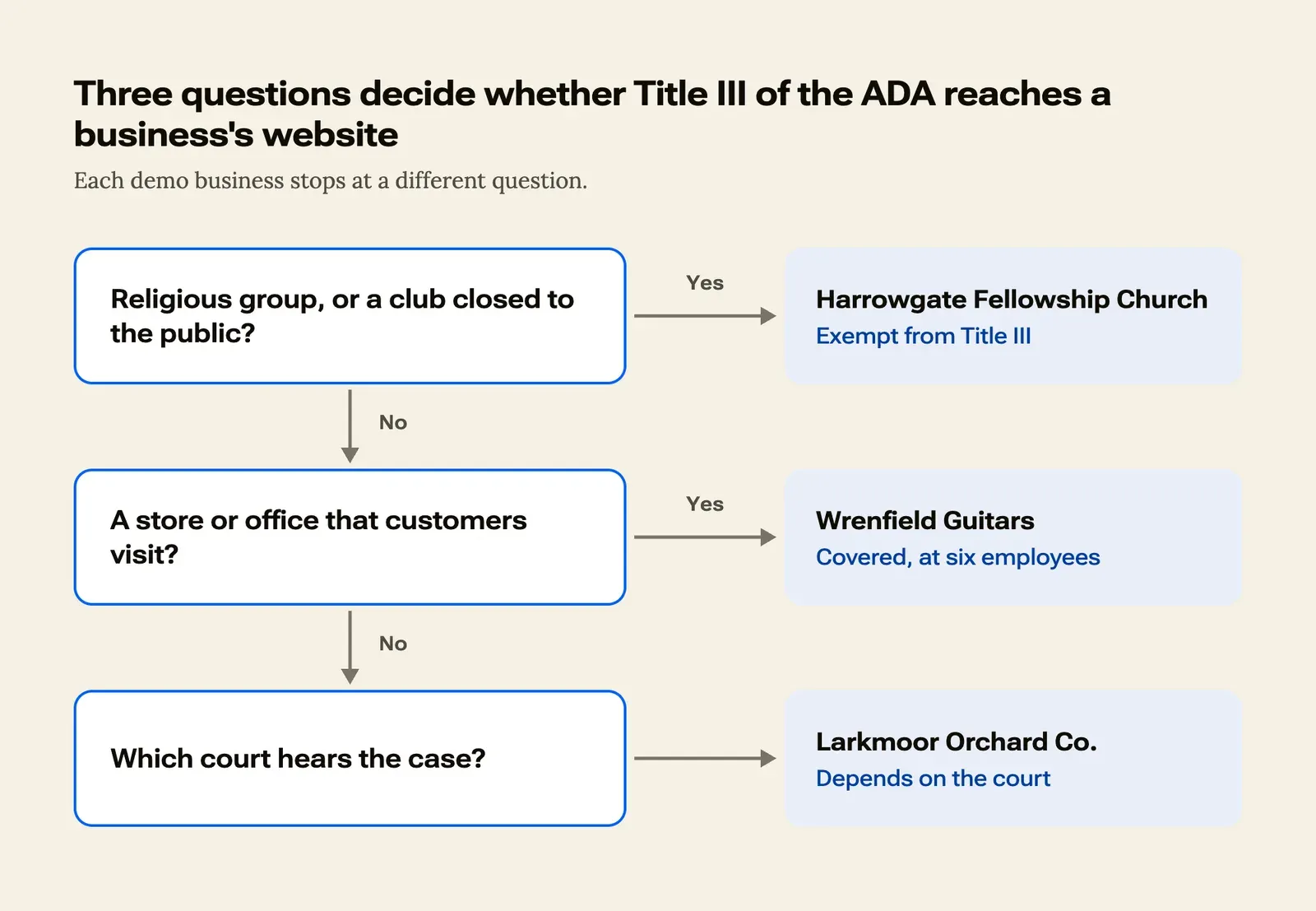
Side by side, the verdicts reverse the ranking that size and reach suggest. The six-person guitar shop is the clear yes, while Larkmoor, which ships its apricots to every state, is the one case the courts disagree on.
 ADA website lawsuit: what it is, what it costs and how to respond
#What does the ADA require of a covered website?
No Justice Department regulation sets detailed web standards for businesses. The department lets each one choose how to make what it offers online accessible, though businesses "must comply with the ADA's requirements," its guidance adds. Its website settlements have named the Web Content Accessibility Guidelines, version 2.1, at Level AA, the version to give a web developer.
In February 2026, the department opposed a class-action settlement over an apparel company's website, in one private case. The settlement committed the company to WCAG 2.1, and the department's court filing tested the settlement's own claims website against that standard. The filing also said the department does not endorse WCAG as a required ADA standard. For a business, WCAG is the yardstick the department's settlements have used. No rule makes it the legal test of a business's compliance.
#How do I know if my website is ADA compliant?
No single check settles it. In an ADA audit, a person tests sampled pages against WCAG. One barrier needs no tool to find, though: play each video on the site with the sound off.
The Justice Department's guidance says a video can be made accessible with captions that keep time with the speech, match it and name who speaks. Captions are one of the communication aids a business owes "where necessary" to communicate effectively.
We played the setup video of our demo shop, Wrenfield Guitars, muted. For a deaf customer, the repair tech's two minutes on string height shrink to a hand moving a steel ruler along a guitar neck. In Chrome 139, the built-in player shows no captions button in its control bar, with or without captions. Its three-dot menu is where to look, and Wrenfield's had no Captions item. Once we added a caption file, Captions appeared there, and each line named the speaker.
Avoid
 Marker 1. The three-dot menu: Download, Playback speed, Picture in Picture, and no Captions item.
Correct
 Marker 1. The Captions item, English, now in the menu. Marker 2. The caption line, which opens with the speaker, Repair tech.
That check took only a muted video, and it found the barrier the Justice Department names for people with hearing disabilities. Wrenfield's headcount played no role, because Title III covers the shop at any headcount.
 ADA website compliance audit: what it checks and how long it takes
For a covered site, an Includdy scan of the home page or the booking page lists its accessibility failures, so the owner sees where it stands before paying for an audit.